
Complete documentation with examples available here.
pyscal grew over the years from a small wrapper around a few C++ routines into a full structural-analysis toolkit. With each addition the original System / Atoms object model became more rigid: every new descriptor had to be threaded through the same class hierarchy, neighbor lists were tied to a particular System instance, and interoperating with the rest of the atomistic-simulation Python ecosystem (ASE, pymatgen, OVITO, LAMMPS dump readers) required converting back and forth between formats.
Version 4 is a ground-up rewrite around four changes:
-
ASE
Atomsis the data structure. pyscal no longer ships its own atoms class. Anyase.Atomsobject, read from a LAMMPS dump, a POSCAR, a CIF, an XYZ, built withase.build.bulk, or constructed by hand, can be passed directly to a pyscal function. Results are written back asatoms.arrays["pyscal_*"]for per-atom quantities andatoms.info["pyscal_*"]for global ones, so they travel with the atoms object and remain accessible to the rest of the ASE ecosystem. -
Functional API. Every descriptor is a top-level function in
pyscalthat takes anAtomsobject as its first argument. Neighbor lists are computed once withpyscal.find_neighbors(atoms, ...)and reused by every subsequent descriptor. There is no system state to keep in sync, no method-chaining order to remember, and no class to subclass when adding a new descriptor. -
Neighbor search on matscipy-neighbours. The neighbor search uses the C++ core of matscipy-neighbours, which is included in pyscal. The neighbors are stored as flat arrays, which the descriptors read directly. For one million atoms with 12 neighbors each, the search takes 0.12 s instead of 28 s in pyscal 3.3.
-
Threads. The neighbor search, common neighbor analysis and the per-atom loops of the descriptors run on all CPU cores. The results are the same for any number of threads.
pyscal.set_num_threads(n)or the environment variablePYSCAL_NUM_THREADSsets the number of threads.
The C++ core keeps voro++ for tessellation and its own kernels for Steinhardt-type invariants and common neighbor analysis, with pybind11 bindings, and is now exposed through a much thinner Python layer.
A typical session looks like:
import pyscal
from ase.build import bulk

atoms = bulk("Cu", "fcc", cubic=True).repeat(4)
pyscal.find_neighbors(atoms, method="cutoff", cutoff=0)   # adaptive
q4, q6 = pyscal.steinhardt_parameter(atoms, l=[4, 6])
labels, names = pyscal.identify_ackland_jones(atoms)

print(atoms.arrays["pyscal_q6"].mean())   # ≈ 0.57 for fcc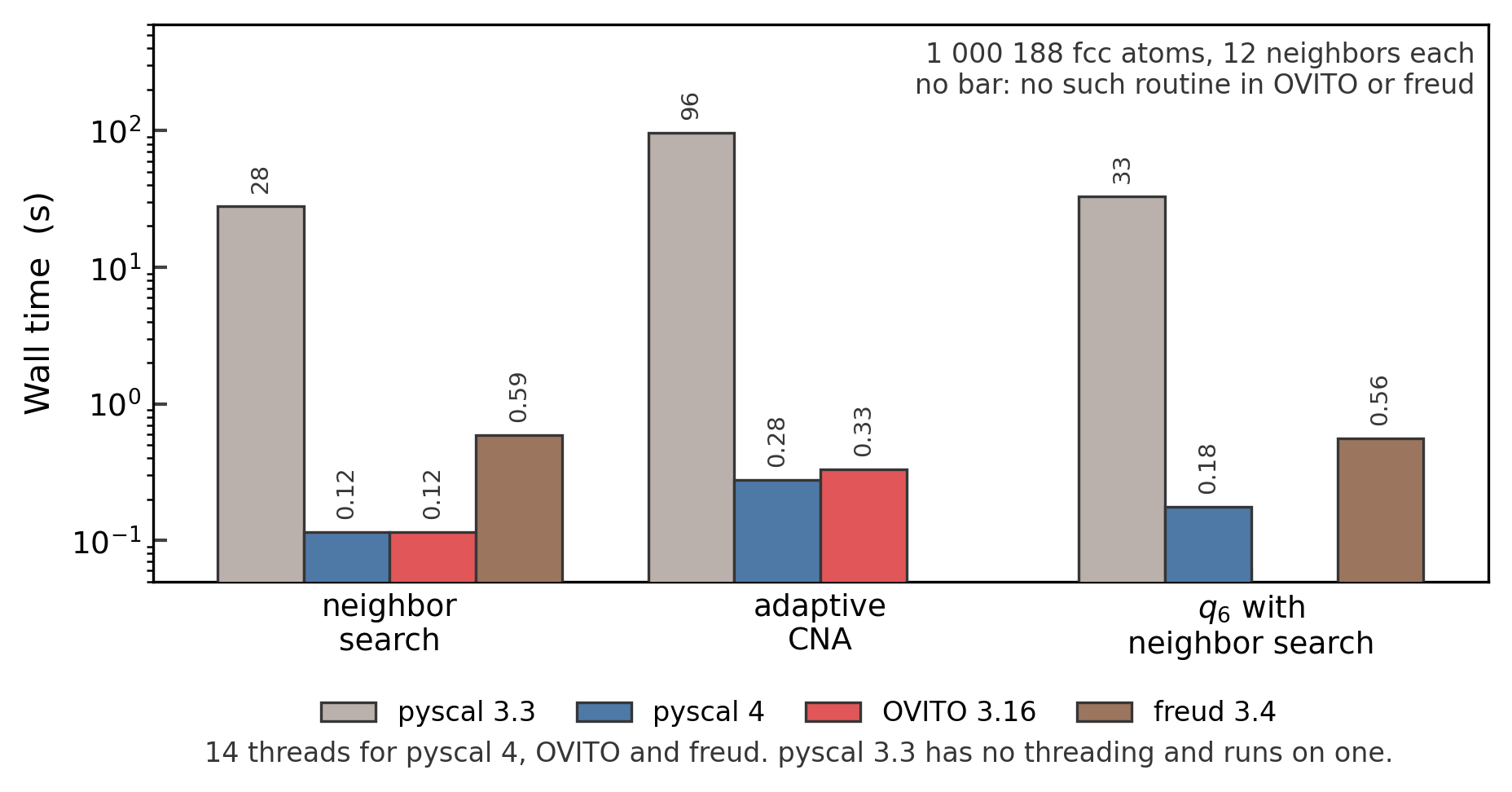
pyscal is as fast as or faster than OVITO and freud.
Scripts written for pyscal 3 need small changes, described in Migrating from pyscal 3. To keep the old interface, install pyscal3<4.
This release consolidates a number of new descriptors alongside the existing ones:
- Neighbors: fixed cutoff, adaptive cutoff, SANN, a fixed number of neighbors, Voronoi
- Steinhardt
$q_l$ and averaged$\bar{q}_l$ - Wigner
$W_l$ : third-order rotational invariants for distinguishing cubic structures - Minkowski structure metrics: Voronoi-area-weighted, parameter-free
$q_l$ - Solid/liquid classification and clustering
- Disorder parameter
- Angular and
$\chi$ parameters, Ackland-Jones structural classifier - Coordination measures: coordination number, effective coordination, generalised coordination, local density
- Angular distribution function and bond-length distribution function
- Voronoi tessellation: structural vector and Voronoi volume
- Centrosymmetry parameter
- Common neighbor analysis (CNA, adaptive CNA, diamond variants)
- Entropy parameter (Piaggi–Parrinello)
- Warren–Cowley short-range order
- Atomic deformation: strain tensor, von Mises invariant,
$D^2_{\min}$ , slip vector - Wigner–Seitz defect analysis: vacancies, interstitials, antisites against a reference
- Atomic Cluster Expansion (ACE) descriptors up to body order four
A complete list with mathematical definitions and examples is available in the documentation.
pyscal is distributed on PyPI and conda-forge as pyscal3 (the name pyscal on PyPI refers to a separate, unrelated package). After installation, both import pyscal and import pyscal3 work.
From conda-forge:
conda install -c conda-forge pyscal3
or from PyPI:
pip install pyscal3
To build from source:
git clone https://github.com/pyscal/pyscal3.git
cd pyscal3
pip install .
A C++ compiler with C++17 support is required when building from source.
pyscal3 includes two C++ libraries in lib/, compiled into its extension module:
- voro++ by Chris H. Rycroft, for Voronoi tessellation.
- matscipy-neighbours by the libAtoms developers, for the neighbour search. MIT licence, see
lib/matscipy-neighbours/LICENSE.mdandVENDORED.mdin the same directory.
If you use pyscal in your work, please cite the following article:
Sarath Menon, Grisell Díaz Leines and Jutta Rogal (2019). pyscal: A python module for structural analysis of atomic environments. Journal of Open Source Software 4(43), 1824. https://doi.org/10.21105/joss.01824
For a list of publications that used pyscal, see here.
Bug reports, questions and contributions are welcome. See Contributing.